
How to Address Mail and Avoid Rejection (checklist) — examples from CoreCivic facility guidance (verify with Citrus County Detention Facility)
Mail gets rejected for two main reasons: missing information on the envelope, or something inside that breaks the rules. Use this checklist as a starting point, then confirm Citrus County Detention Facility's current requirements before sending anything.
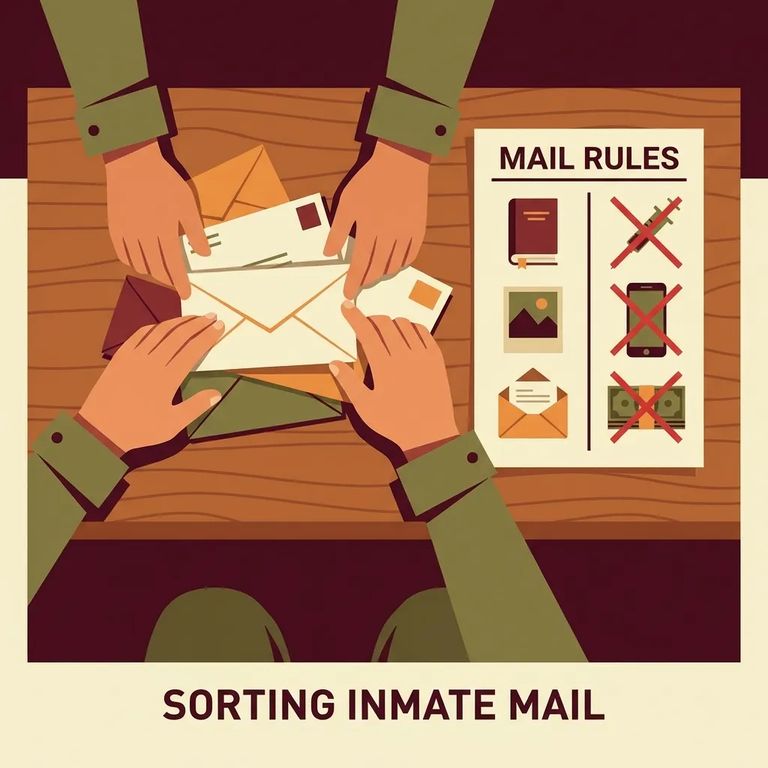
Check Citrus County Detention Facility's mail rules before sending anything. The examples below come from CoreCivic facility guidance and highlight details that often matter - like including an ID number or housing location (dorm/bed). Local policies may be stricter or formatted differently. Your safest bet: verify the exact mailing address the facility wants, which delivery services they accept, and any extra details your loved one needs on the envelope to avoid having your letter returned.

Minimum Envelope Info
- ✓ Recipient’s full name (as booked)
- ✓ Recipient’s identification number (ID#); for detainees, this may be an Immigration A#
- ✓ Housing/location information if the facility uses it (examples from CoreCivic facilities include dorm/bed)
- ✓ Facility name and full mailing address (Citrus County Detention Facility lists a mailing address of PO Box 22997, Tampa, FL 33634)
- ✓ Your full name and full return address (no missing apartment/unit details)
Example layout: Recipient Full Name + ID#/A# (+ dorm/bed if required) on the first lines, then the facility name and mailing address; put your full return name and address in the upper-left corner.
CoreCivic mail guidance typically requires general correspondence to arrive in a standard letter-size or legal-size envelope. Carrier rules matter too - many facilities expect regular mail service and will reject or delay items that arrive differently. Citrus County's rules may vary, so treat "standard letter/legal envelope" as a safe default. If you're sending anything unusual (large envelopes, packages, padded mailers, or courier deliveries), verify it's allowed before mailing.
Items Trigger Rejection
- ✓ Hazardous materials (especially anything not properly marked/packaged)
- ✓ Perishable items (especially anything not properly marked/packaged)
- ✓ Obscene/vile content or content that incites violence or terrorism
- ✓ Solicitations designed to look like a bill (unless they include a prominent disclaimer)
- ✓ Mail that claims USPS/Postmaster approval or compliance with postal law
- ✓ Deliberate imitations of postal markings or trademarks (for example, “Priority Mail” lookalikes)
- ✓ Maps of the city where the facility is located or nearby communities
- ✓ Polaroid photos
- ✓ Photo negatives or slides
- ✓ Photo albums
- ✓ Photos of current or former employees
- ✓ Framed photos
- ✓ Greeting cards larger than 8" x 10"
- ✓ Greeting cards with electronic parts or other non-paper parts
- ✓ Greeting cards constructed to conceal contraband
- ✓ Stick-on labels or stamps that appear to contain contraband
- ✓ Anything glued, taped, stapled, or otherwise affixed to a page (extra items attached to the paper)
- ✓ Any item prohibited by law, regulation, or contract
Quick tip: The “surprise rejects” in CoreCivic examples are Polaroids and greeting cards - especially oversized cards, cards with music/electronic pieces, or layered cards that could hide contraband.
Certain mail gets special or confidential treatment when it comes from approved senders. In CoreCivic examples, that includes elected officials, judges and courts, licensed attorneys, foreign consulate officials, certain legal organizations, and government or facility officials connected to custody, parole, or probation. Citrus County's list may differ. If you're sending legal or official mail, confirm who qualifies and what envelope markings the facility requires.
Labeling example: In CoreCivic guidance, approved special-correspondent envelopes are marked “Confidential/Legal Mail.” Use that only when the sender qualifies under the facility’s rules.
Mail inspection is another common reason items get delayed or rejected. One CoreCivic example tied to ICE detention standards says general correspondence for ICE detainees is opened and inspected in the detainee's presence - unless the warden authorizes inspection without them for security reasons. Citrus County's process may differ, but the principle holds: anything that looks like it could hide contraband (extra layers, taped items, unusual inserts) is more likely to get flagged.
- Ask whether your loved one can reject general mail inspection - one CoreCivic facility allows residents to opt out of having incoming general correspondence reviewed.
- Have them submit the facility’s rejection form to the mailroom - in the CoreCivic example, the inmate/resident completes a “Rejection of General Correspondence” form and turns it in to the Facility Mailroom.
- Expect unopened letters to come back - after the form is on file in that example, general correspondence isn’t opened; it’s marked “returned to sender” and sent back to the local post office.
- If your mail is returned, re-check the envelope details first - missing required info (name/ID/housing) is a common reason mail gets kicked back even when the contents are fine.
Quick Printable Checklist
- ✓ Use the facility’s exact mailing address and format (Citrus County Detention Facility lists PO Box 22997, Tampa, FL 33634)
- ✓ Write the recipient’s full name and ID number clearly
- ✓ Add any required housing/location info if Citrus County uses it (some facilities require dorm/bed)
- ✓ Include your full return name and address on every envelope
- ✓ Stick to a standard letter-size or legal-size envelope for general correspondence (common in CoreCivic examples)
- ✓ Don’t send hazardous or perishable items
- ✓ Don’t send obscene material or anything that incites violence/terrorism
- ✓ Avoid mail pieces that mimic bills without a prominent disclaimer
- ✓ Don’t use fake/imitated postal markings or postal trademarks
- ✓ Skip Polaroids, negatives/slides, photo albums, and framed photos
- ✓ Don’t include photos of current or former facility employees
- ✓ Don’t send oversized greeting cards (over 8" x 10")
- ✓ Don’t send greeting cards with electronics or other non-paper parts
- ✓ Don’t send layered/constructed cards or items designed to conceal contraband
- ✓ Don’t attach extras to pages (no glued/taped/stapled add-ons)
- ✓ If you’re qualified special correspondence, follow the facility’s rules for marking “Confidential/Legal Mail”
Verify before you send: Address formats, accepted carriers, photo/card rules, and “special correspondence” handling can vary by facility and change over time - confirm Citrus County Detention Facility’s current mail policy first.
Find an Inmate at Citrus County Detention Facility, FL
Search for a loved one and send messages and photos in minutes.