
What Security Level Is FCI Texarkana? Understanding a Low‑Security FCI
To understand what
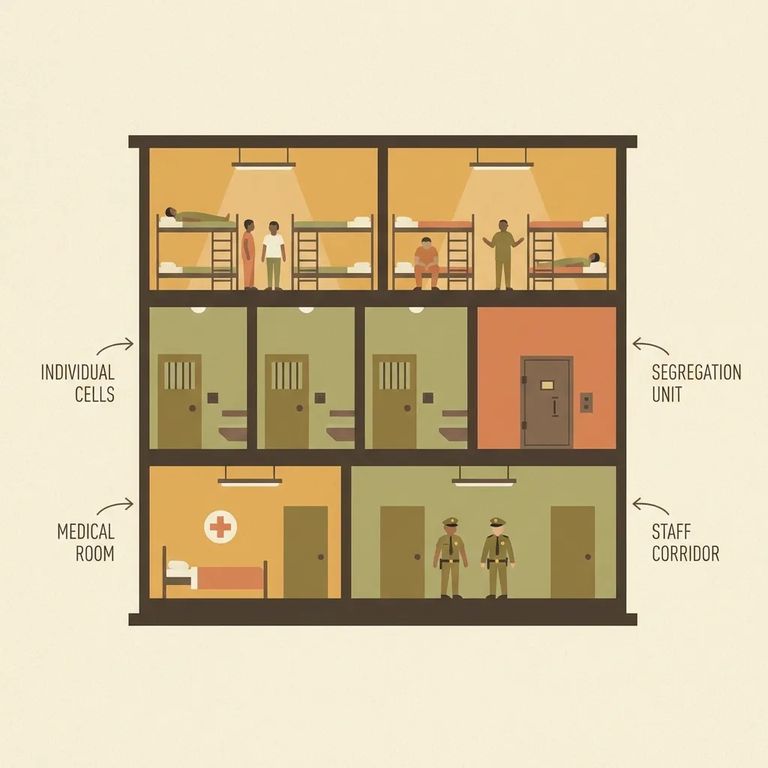
The Bureau of Prisons (BOP) groups its institutions into five security levels: minimum, low, medium, high, and administrative. Those labels aren’t just shorthand - they reflect real differences in how a prison is built and how it operates. The BOP distinguishes these security levels using a few core features: the type of housing inside the institution, whether there are external patrols/towers/security barriers or electronic detection devices, the internal security features used to control movement and supervise people, and the staff-to-inmate ratio. So when you hear “low security,” think: more structure and security hardware than a minimum-security camp, but not the same level of restrictions you’d expect at a medium or high-security facility.
2
- ✓ A double-fenced perimeter with electronic detection systems
- ✓ Mostly dormitory or cubicle-style housing (rather than being exclusively single-cell housing)
- ✓ Security level features that can include barriers/detection devices and other internal security controls, since the BOP distinguishes security levels based on perimeter measures and internal security features as well as housing type
Staffing is part of the “feel” of a low-security FCI, too. The BOP describes low-security FCIs as having a staff-to-inmate ratio that is somewhat higher than minimum-security Federal Prison Camps (FPCs). In plain terms, that usually means more routine supervision than a camp setting, along with more formal controls around day-to-day operations.
Classification shows up in everyday life through two big levers: housing and controls. In a low-security FCI, people are generally housed in dormitory or cubicle-style settings, which means daily living is more communal than it would be in a facility built mostly around single cells. That can shape everything from privacy to how counts and schedules are managed. At the same time, “low security” still signals a meaningful security footprint. The BOP uses perimeter barriers and detection devices - along with internal security features - as key markers of security level. Practically, that usually translates to clearer boundaries on where someone can go and when, with movement and supervision designed around those internal controls rather than the looser environment you may associate with minimum-security camps.
Placement in the federal system isn’t decided by the facility itself. The BOP’s Designation and Sentence Computation Center (DSCC) in Grand Prairie, Texas is the office that designates people to appropriate federal facilities, and it also calculates sentences based on information from the sentencing court along with federal laws and Bureau policy. That’s why security level matters so much for placement: it’s one of the core factors the BOP uses to match someone to an institution type - including whether a person is designated to a low-security FCI.
Tip: Because DSCC handles designations, the clearest “why here?” answers usually come from designation paperwork. If your loved one has questions about being placed at a particular facility, have them review their designation documents and use official BOP channels inside the institution to ask for clarification.
Find an Inmate at FCI TEXARKANA, TX
Search for a loved one and send messages and photos in minutes.